google.com, pub-2829829264763437, DIRECT, f08c47fec0942fa0

Tuesday, March 6, 2018

Flying in the Face of God

Flying in the Face of God


Nina Allan (Read the full story in The Best Year’s Science Fiction Anthology 2011, edited by Gardner Dozois)

Civilian flights to the States had become almost prohibitively expensive, but Clement Anderson had supported Anita’s visa application, which had enabled her to claim back some of the cost in the form of a research grant.

A junior officer had met her in the airport and escorted her to a motel a short bus ride from the base. Then there were the inevitable protocols, two days of debriefing and form-filling. She had asked if she could film these processes but her request had been politely denied.

The flight crew of the Aurora 6 were now being kept in more or less permanent isolation. Each member was allowed one last visit prior to launch day, a final thirty minutes with a friend or family member from outside. Anita had been able to speak to Rachel several times on the telephone but she had always assumed the visit would go to Serge. The invitation came out of the blue.
Two women in discussion. Anita touched Rachel’s hand, thinking how from the other side of the two-way mirror they must look like two actors in some prison drama (Nina Allan). Illustration: © Megan Jorgensen

Finally she was taken to a room that was bare of everything except a table and two chairs and in the corner a low sofa covered in a brown leatherette. There was a pane of smoked glass set into one wall that she guessed was a two-way-mirror. At the end of some ten minutes’ waiting the door opened and Rachel appeared. She was dressed in grey overalls, silk or some synthetic substitute. What remained of her hair was mostly hidden under a close-fitting cap that remained Anita of the caps worn by surgeons in the operation theatre. The few strands of hair that were showing looked dry and brittle, almost like tufts of grass.

Her lips were the colour of beetroot. They looked stuck to her face more than part of it, fissured and clotted as scabs.

She closed the door behind her and stepped into the room. Her wrists, poking out from the loose sleeves of the overall, were skeletal, her fingernails thickened and black. Her eyes were hard and glazed, barely human. It was only in the delicate line of her jaw, the fine, high arch of her brow, that any traces of her beauty now remained.

Anita got up from the table and went towards her. She felt a dull ache beneath her breastbone, as if she were trying to hold her breath underwater.

In-fall

In-fall

By Ted Kosmatka


Excerpt. You can read the full text in The Year’s Best Science Fiction, twenty-eighth annual collection, edited by Gardner Dozois, first edition July 2011

The disc caved a hole in the starshine.

Smooth, grapheme skin reflected nothing, blotting out the stars as it swung through the vacuum – black on black, the perfect absence of color.

It was both a ship and not a ship.

The disc lacked a propulsion system. It lacked navigation. Inside, two men awakened, first one and then the other.

In truth, the disc was a projectile – a dark bolus of life support fired into distant orbit around another, stranger kind of darkness.

This second darkness is almost infinitely larger, massing several hundred thousand sols; and it didn’t blot out the stars behind it, but instead lensed them into a bright, shifting halo, bending light into a ring, deforming the fabric of spacetime itself.

From the perspective of the orbiting disc, the stars seemed to flow around an enormous, circular gap in the star field. It had many different names, this region of space. The astronomers who discovered it centuries earlier had called it Bhat 16. Later physicists would call it “the sink”. And finally, to those who came here, to those who dreamed of it, it was known simply as “the maw”.

Adverse univers. And the universe ticked on (Ted Kosmatka). Illustration by © Megan Jorgensen (Elena)

A black hole like none ever found before.

By the disc’s third day in orbit, it had already traveled three-hundred and eighteen million miles, but this is only a tiny fraction of its complete trajectory. At the end of the disc’s seventy-second hour in orbit, a small lead weight, 100 kilograms, was fired toward the heart of the gravity well – connected to the ship by a wire so thin that even mathematician called it a line.

The line spooled out, thousands of kilometers of unbreakable tetravalent filament stretching toward the darkness until finally pulling taut. The line held fast to its anchor point, sending a musical resonance vibrating a musical resonance vibrating through the disc’s carbon hull.

Inexorable gravity, a subtle shift.

Slow at first, but gradually, on the fourth day, the ship that was not a ship changed course and began to fall.

Libertarian Russia

Libertarian Russia

By Michael Swanwick


The Year’s Best Science Fiction anthology 2011, edited by Gardner Dozois

“Not me. I‘ve already found what I’m looking for – Libertarian Russia. Right here, where we are”. Victor finished with the chicken, and began cutting up the vegetables. It would take a while for the fire to die down to coals, but when it was ready, he’d roast the vegetables and chicken together on spits, shish kebob style.

“Now that you’ve found it, what are you going to do with it?”

“Nothing. Wander around. Live here. Whatever.” He began assembling the kabobs. “You see, after the Depopulation, there just weren’t the resources anymore for the government to police the largest country in the world with the sort of control they were used to. So instead of easing up on the people, they decided to concentrate their power in a handful of industrial and mercantile centers, port cities and the like. The rest, with a total population of maybe one or two people per ten square miles, they cut loose. Nobody talks about it, but there’s no law out here except what people agree upon. They’ve got to settle their differences among themselves. When you’ve got enough people to make up a town, they might pool their money to hire a part-time cop or two. But no databases, no spies… you can do what you like, and so long as you don’t infringe upon somebody else’s freedoms, they’ll leave you alone”.

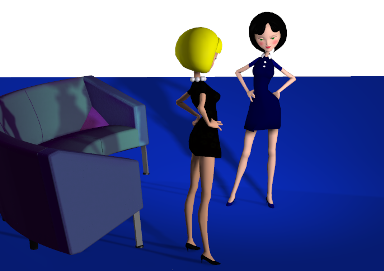
Blonde Woman Standing. “Trust me, my body is all the weapon I need” (Michael Swanwick). Illustration: © Megan Jorgensen (Elena)

Everything Victor said was more or less-cut-and-paste from “Free Ivan,” an orphan website he’d stumbled on five years ago. In libertarian circles, Free Ivan was a legend. Victor liked to think he was out somewhere in Siberia, living the life he’d preached. But since his last entry was posted from St. Petersburg and mentioned no such plans, most likely he was dead. That was what happened to people who dared imagine a world without tyranny.

“What is somebody else’s idea of freedom involves taking your motorcycle from you?”

Victor got up and patted the contact plate on his machine. “The lock is coded to my genome. The bike won’t start for anybody else. Anyway, I have a gun.” He showed it, then put it back in his shoulder harness.

“Somebody could take that thing away from you and shoot you, you know.”

“No, they couldn’t. It’s a smart gun. It’s like my bike – it answers to nobody, but me.”

Unexpectedly, Svetlana laughed. “I give up! You’ve got all the angles covered.”

Yet Victor doubted he had convinced her of anything. “We have the technology to make us free,” he said sullenly. “Why not use it?” You ought to get a gun yourself.”

Monday, March 5, 2018

My Father’s Singularity

My Father’s Singularity

By Brenda Cooper


Letting my father lose the farm wasn’t a choice I could even imagine. I’d go over to Seattle and go to school. After, I’d get a job and send money home, the way the Mexicans did when I was little and before the government gave them part of our land to punish us. Not that we were punished. We liked the Ramirezes and the Alvarezes. They, too, needed me to save the farm.

But that’s not this story. Except that Mona Alvarez drove me to Leavenworth to catch the silver Amtrak train, her black hair flying away from her lipstick-black lips, and her black painted fingernails clutching the treacherous steering wheel of our old diesel truck. She was so beautiful I decided right then that I would miss her almost as much as I would miss my father and the bending apple trees and the working dogs and the sheep. Maybe I would miss Mona even more.

Mona, however, might not miss me. She waved once after she dropped me off, and then she and the old truck were gone and I waited amid the electric cars and the old tourists with camera hats and data jewelry and the faint marks of implants in the soft skin between their thumbs and their index fingers. They looked like they saw everything and nothing all at once. If they came to our farm the coyotes and the repatriated wolves would run them down fast.

On the other end of the train ride, I found the University of Washington, now sprawled all across Seattle, a series of classes and meet ups and virtual lessons that spidered out from the real brick buildings. An old part of the campus still squatted by the Montlake Cut, watching over water and movement that looked like water spiders but was truly lines of people with oars on nanofab boats as thin as paper.

Maybe I believed too much happiness would kill me, or change me. Or maybe I just couldn’t move slow enough to breathe in the apple air anymore (Brenda Cooper). Illustration: © Megan Jorgensen (Elena)

Our periodic family trips to Seattle hadn’t really prepared me for being a student. The first few years felt like running perpetually uphill, my brain just not going as fast as everyone else’s.

I went home every ear. Mona married one of the Ramirez boys and had two babies by the time three years had passed, and her beauty changed to a quite softness with no time to paint her lips or her nails. Still, she was prettier than the sticks for girls that chewed calorie-eating gum and did their homework while they ran to Gasworks Park and back on the Burke-Gilman Trail, muttering answers to flashcards painted on their retinas with light.

I didn’t date those girls; I wouldn’t have known how to interrupt the speed of their lives and ask them out. I dated storms of data and new implants and the rush of ideas until by my senior year I was actually keeping up.

When I graduated, I got a job in genetics that paid well enough for me to live in an artist’s loft in a green built row above Lake Union. I often climbed onto the garden roof and sat on an empty bench and watched the Space Needle change decorations every season and the little wooden boats sailing on the still lake below me. But mostly I watched over my experiments, playing with new medical implants to teach children creativity and to teach people docked for old age in the University hospital how to talk again, how to remember.

(Excerpt from The Year’s Best Science Fiction, 2011 Collection, edited by Gardner Dozois).

Jackie’s Boy

Jackie’s Boy

Steven Popkes


(Excerpt, the full text can be found in The Best Year’s Science Fiction Anthology 2011, edited by Gardner Dozois)

Pinto kept a wary eye on Michel but he ignored her. The sun was hot even on his sweating body. He didn’t want to imagine what Jackie felt like.

“Keep her ear wet, too,” Pinto told him. “Elephants keep cool through their ears.” Michael grunted and bathed Jackie’s ears.

“Did she knock you down?” Pinto asked as they passed one another on the way to the river.

“She saved my life,” Michael said simply.

“Right.”

Michael shrugged.

Samsa returned with two buckets and a rifle. “I thought you liked poison,” Michael said.

“Michael shouldered the rifle and climbed up over his neck. He looked around. The blue bowl of the sky above him, the warm sun, his gray family patiently waiting for him half a mile away. He felt like singing.” (Steven Popkes). Photo by © Megan Jorgensen (Elena)

“I do. But it’s hard to penetrate the hide of a crocodile with a dart.”

“There are crocodiles in the river?”

“Not usually this far north but sometimes. The Komodos usually stay away, too. But not always. I’ll keep watch, just in case.”

Michael stopped and looked at Samsa. “You were a Keeper at Hohenwald.”

“Director,” Samsa corrected.

“So you let the elephants go when everybody died?” Samsa cocked his head, “Eleven years ago.”

“All the other elephants in Saint Louis died. Jackie and the Keeper decided she should look for the elephants down here.”

“Did they, now?”

“Jackie’s going to have a baby. Is the poison going to hurt it?”

Samsa sighed and looked over to her still form. “I should have picked that up right away.” He turned back to Michael. “I hope not but there’s no way to know. If she doesn’t miscarry, it’s a fair bet the baby will be all right.” Samsa gestured to Michael. When Michael came close enough, Samsa untied his hands.

“I’m starting to believe you’re not a poacher.” He help up the gun. “But I still have the rifle.”Michael nodded and went back to filling buckets.

In the early afternoon, Jackie started twitching. An hour later, she was trying to get up. Samsa stood next to her, speaking soothingly.

“Don’t get up yet, girl.” He gestured Michael and Pinto off the sand bank.

Jackie seemed to calm down and remained still. But it wasn’t long until she heard hereself up, swaying and looking confused.

“It’s okay, girl,” Samsa said soothingly.

Jackie swung her trunk and knocked the rifle to the ground, then swing back, caught Samsa’s leg and turned him over on his back. It a moment, she had a foot on his chest.

“You tried to kill my boy,” she hissed. Samsa tried to speak but couldn’t.

Pinto ran to Jackie and tried to pull up her foot. Jackie ignored her. “Are you all right, Michael?”

“Yeah.”

“What do you want me to do with him?”

“Let him go,” Michael said. “He’s the director at Hohenwald.”

Jackie slowly raised her foot. She carefully walked down the sandbar into the water and eased into it.

Pinto held Samsa’s hand. She was crying. Michael squatted down next to him. “She can talk,” Samsa coughed out.

“I know,” Michael said.