google.com, pub-2829829264763437, DIRECT, f08c47fec0942fa0

Wednesday, March 7, 2018

Elegy for a Young Elk

Elegy for a Young Elk


Hannu Rajaniemi (excerpt, see the full text in The Best Year’s Science Fiction Anthology 2011, edited by Gardner Dozois

… The quantum girl had golden hair and eyes of light. She wore many faces at once, like a Hindu goddess. She walked to the pier with dainty steps. Esa’s summerland showed its cracks around her: there were fracture lines in her skin, with otherworldly colours peeking out.

“This is Sade,” Esa said.

She looked at Kosonen, and spoke, a bubble of words, a superposition, all possible greetings at once.

“Nice to meet you,” Kosonen said.

“They did something right when they made her, up-there,” said Esa. “She lives in many worlds at once, thinks in qubits. And this is the world where she wants to be. With me.” He touched her shoulder gently. “She heard my songs and ran away”.

“Marja said, she fell,” Kosonen said. “That something was broken.”

“The poem rose from the words like a titanic creature from an ocean, first showing just a small extremity but then soaring upwards in a spray of glossolalia, mountain-like”. (Hannu Rajaniemi). Elegy for a young elk. Photo by Elena

“She said what they wanted her to say. They don’t like it when things don’t go according to plan.”

Säde made a sound, like a chime of a glass bell.

“The firewall keeps squeezing us,” Esa said. “That’s how it was made. Make things go slower and slower here, until we die. Säde doesn`t fit in here, this place is too small. So you will take her back home, before it`s too late.” He smiled. “I’d rather you do it than anyone else.”

“That’s not fair,” Kosonen said. He squinted at Säde. She was too bright to look at. But what can I do? I am just a slab of meat. Meat and words.

The thought was like a pinecone, rough in his grip, but with a seed of something in it.

“I think there is a poem in you two,” he said.

Flower, Mercy, Needle, Chain

Flower, Mercy, Needle, Chain

By Yoon Ha Lee


“Yes,” Kerang says. “I have been charged with preventing further assassinations. Arighan’s Chain is not a threat I can afford to ignore.”

“Why didn’t you come earlier, then?” Shiron says. “After all, the Chain might have lain dormant, but the others – “

“I’ve seen the Mercy and the Needle,” he sais, by which he means he’s copied data from those who have. “They’re beautiful.” He isn’t referring to beauty in the way of shadows fitting together into a woman’s profile, or beauty in the way of sun-colored liquor at the right temperature in a faceted glass. He means the beauty of logical strata, of the crescendo of axiom-axiom-corollary-proof, of quod erat demonstrandum.

“Any gun or shard of glass could do the same as the Mercy,” Shiron says, understanding him. “And drugs and dreamscalpels will do the Needle’s work, given time and expertise. But surely you could say the same of the Chain.”

She stands again and takes the painting of the mountain down and rolls it tightly. “I was born on that mountain,” she says. “Something lite it is still there, on a birthworld very like the one I knew. But I don’t think anyone paints in this style. Perhaps some art historian would recongnize its distant cousin. I am no artist, but I painted it myself, because no one else remembers the things I remember. And now you would have it start again.

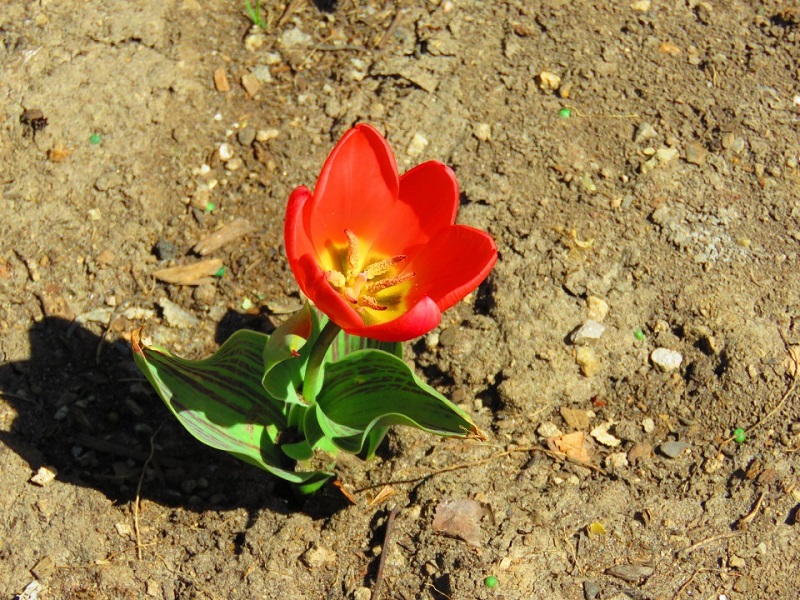
Merci, Needle, Chain... No Flowers... Photo by Elena

“Now many bullets have you used?” Kerang asks.

It is not that the Flower requires special bullets – it adapts even to emptiness – it is that the number matters.

Shiron laughs, low, almost husky. She knows better than to trust Kerang, but she needs him to trust her. She pulls out the Flower and rests it in both palms so he can look at it.

Three petals fallen, a fourth about to follow. That’s not the number, but he doesn’t realize it. “You’ve guarded it so long,” he says, inspecting the maker’s mark without touching the gun.

“I will guard it until I’m nothing but ice,” Shiron says. “You may think that the Chain is a threat, but if I remove it, there is no guarantee that you will still exist…”

“It is not the Chain I want destroyed,” Kerang says gently. “It’s Arighan. Do you think I would have come to you for anything less?”

Shiron says into the awkward quiet, after a while, “So you tracked down descendants of Arighan line.” His silence is assent. “There must be many.”

(Read the full text in The Best Year’s Science Fiction Anthology 2011, edited by Gardner Dozois). 

Tuesday, March 6, 2018

Flowers of the Planet

The Wonders and Mysteries of Nature


From historians to witchcraft adepts, nature has fascinated mankind since times immemorial. According to evolutionary psychologists, humans evolved to adapt to their environments, and coping with natural forces was a prerequisite to reproductive fitness and long term survival.

Today’s fears and anxieties over global warming and environmental and climate change remain a chilling topic. The importance of recycling and going green can only be understated. In hopes of a greener future, the following images were compiled based on their common theme: plants or flora. Other thematic gallery groupings can be found on the art index page.

Out of difficulties grow miracles (Jean de la Bruyere)
Follow your bliss and the universe will open doors where there were only walls (Joseph Campbell)
You must do the things you think you cannot do (Eleanor Roosevelt)
Your big opportunity may be right where you are now (Napoleon Hill)
Even if I knew that tomorrow the world would go to pieces, I would still plant my apple tree (Martin Luther)
No matter what people tell you, words and ideas can change the world (Robin Williams)
Change your thoughts and you change your world (Norman Vincent Peale)

Try to be like a turtle - at ease in your own shell (Bill Copeland)
Thought is the wind, knowledge the sail, and mankind the vessel (Augustus Hare)
Don’t judge each day by the harvest you reap but by the seeds that you plant (Robert Louis Stevenson)
Be brave enough to live life creatively. The creative place where no one else has ever been (Alan Alda)
Wonder rather than doubt is the root of all knowledge (Abraham Joshua Heschel)
Health is the greatest gift, contentment the greatest wealth, faithfulness the best relationship (Buddha)
We can’t help everyone, but everyone can help someone (Ronald Reagan)

Believe you can and you’re halfway there (Theodore Roosevelt)

Enthusiasm moves the world (Arthur Balfour)

Flying in the Face of God

Flying in the Face of God


Nina Allan (Read the full story in The Best Year’s Science Fiction Anthology 2011, edited by Gardner Dozois)

Civilian flights to the States had become almost prohibitively expensive, but Clement Anderson had supported Anita’s visa application, which had enabled her to claim back some of the cost in the form of a research grant.

A junior officer had met her in the airport and escorted her to a motel a short bus ride from the base. Then there were the inevitable protocols, two days of debriefing and form-filling. She had asked if she could film these processes but her request had been politely denied.

The flight crew of the Aurora 6 were now being kept in more or less permanent isolation. Each member was allowed one last visit prior to launch day, a final thirty minutes with a friend or family member from outside. Anita had been able to speak to Rachel several times on the telephone but she had always assumed the visit would go to Serge. The invitation came out of the blue.

Two women in discussion. Anita touched Rachel’s hand, thinking how from the other side of the two-way mirror they must look like two actors in some prison drama (Nina Allan). Illustration: © Megan Jorgensen

Finally she was taken to a room that was bare of everything except a table and two chairs and in the corner a low sofa covered in a brown leatherette. There was a pane of smoked glass set into one wall that she guessed was a two-way-mirror. At the end of some ten minutes’ waiting the door opened and Rachel appeared. She was dressed in grey overalls, silk or some synthetic substitute. What remained of her hair was mostly hidden under a close-fitting cap that remained Anita of the caps worn by surgeons in the operation theatre. The few strands of hair that were showing looked dry and brittle, almost like tufts of grass.

Her lips were the colour of beetroot. They looked stuck to her face more than part of it, fissured and clotted as scabs.

She closed the door behind her and stepped into the room. Her wrists, poking out from the loose sleeves of the overall, were skeletal, her fingernails thickened and black. Her eyes were hard and glazed, barely human. It was only in the delicate line of her jaw, the fine, high arch of her brow, that any traces of her beauty now remained.

Anita got up from the table and went towards her. She felt a dull ache beneath her breastbone, as if she were trying to hold her breath underwater.

In-fall

In-fall

By Ted Kosmatka


Excerpt. You can read the full text in The Year’s Best Science Fiction, twenty-eighth annual collection, edited by Gardner Dozois, first edition July 2011

The disc caved a hole in the starshine.

Smooth, grapheme skin reflected nothing, blotting out the stars as it swung through the vacuum – black on black, the perfect absence of color.

It was both a ship and not a ship.

The disc lacked a propulsion system. It lacked navigation. Inside, two men awakened, first one and then the other.

In truth, the disc was a projectile – a dark bolus of life support fired into distant orbit around another, stranger kind of darkness.

This second darkness is almost infinitely larger, massing several hundred thousand sols; and it didn’t blot out the stars behind it, but instead lensed them into a bright, shifting halo, bending light into a ring, deforming the fabric of spacetime itself.

From the perspective of the orbiting disc, the stars seemed to flow around an enormous, circular gap in the star field. It had many different names, this region of space. The astronomers who discovered it centuries earlier had called it Bhat 16. Later physicists would call it “the sink”. And finally, to those who came here, to those who dreamed of it, it was known simply as “the maw”.

Adverse univers. And the universe ticked on (Ted Kosmatka). Illustration by © Megan Jorgensen (Elena)

A black hole like none ever found before.

By the disc’s third day in orbit, it had already traveled three-hundred and eighteen million miles, but this is only a tiny fraction of its complete trajectory. At the end of the disc’s seventy-second hour in orbit, a small lead weight, 100 kilograms, was fired toward the heart of the gravity well – connected to the ship by a wire so thin that even mathematician called it a line.

The line spooled out, thousands of kilometers of unbreakable tetravalent filament stretching toward the darkness until finally pulling taut. The line held fast to its anchor point, sending a musical resonance vibrating a musical resonance vibrating through the disc’s carbon hull.

Inexorable gravity, a subtle shift.

Slow at first, but gradually, on the fourth day, the ship that was not a ship changed course and began to fall.