google.com, pub-2829829264763437, DIRECT, f08c47fec0942fa0

Sunday, October 7, 2018

Rocky Mountain National Park

Rocky Mountain National Park


3 million visitors per year – 414 square miles – One of the highest regions in the country – 114 mountains above 10,000 feet – Superintendent, Estes Park.

On both sides of Rocky Mountain National Park's 44-mile Trail Ridge Road, the highest paved road in America, are craggy snow-capped mountain peaks shrouded in clouds, alpine fields ablaze with wildflowers, and crystal-clear mountain lakes. Elk, deer, mouse, coyotes, marmots, ptarmigan and the bighorn sheep – the symbol of the park – can often be seen.

Peak season tips: The road to Bear Lake is one long traffic jam in the summer. Consider spending most of your time on the west side of the park; it's less spectacular, but also less crowded, and there are better opportunities to see wildlife.

Camping: There are five campgrounds in the park, each with a seven-day camping limit. For reservations to Moraine Park and Glacier Basin campgrounds, call Mistix. The other three are available on a first-come, first-served basis. In the summer, Timber Creek, on the west side of the park, is recommended – it doesn't fill up until about 2 p.m. Aspenglen and Longs Peak, where one begins the ascent to the summit, are often full by 8 a.m. Privately owned campgrounds also are available.

Best one-day trip: For a sampling of the varied topography, take Fell River Road to the Alpine Visitors Center at Fall River pass, 11,796 feet above sea level. Drive back along Trail Ridge Road. If time permits, turn off Trail Ridge road onto Bear Lake Road, which winds past lakes and streams to Bear Lake, where there is an easy a 1.1-mile hike to Dream Lake. A less-crowded trail nearby is the Glacier Gorge Junction Trail to Alberta Falls. Those who are in peak physical condition may want to attempt Long's Peak Trail, a strenuous 8-mile hike. A third of the 15,000 people who attempt it every year don't make it – at 14,000 feet, there is 40 percent less oxygen in the air.

Best experience: Eighty percent of the park's trails can be ridden on horseback, and there are two historic ranches at the center of the park. Horses can be rented from livery concessions in Glacier Basin and Moraine Park. For a list of nearby ranches, many of which of offer accommodations, contact the park administration. 

Flowers blossom. Photo by Elena.

Manhattan - Part I

New York, Manhattan, Part I


Manhattan is coextensive with New York County, one of the original counties of the U.S. state of New York. The borough consists mostly of Manhattan Island, bounded by the Hudson, East, and Harlem rivers; several small adjacent islands; and Marble Hill, a small neighborhood now on the U.S. mainland, physically connected to the Bronx and separated from the rest of Manhattan by the Harlem River. Manhattan Island is divided into three informally bounded components, each aligned with its long axis: Lower, Midtown, and Upper Manhattan.

Manhattan is the cultural, financial, media, and entertainment capital of the world, and the borough hosts the United Nations Headquarters. Anchored by Wall Street in the Financial District of Lower Manhattan, New York City has been called both the most economically powerful city and the leading financial center of the world. Manhattan is home to the world's two largest stock exchanges by total market capitalization: the New York Stock Exchange and NASDAQ. 

Many multinational media conglomerates are based in Manhattan, and the borough has been the setting for numerous books, films, and television shows. Manhattan is historically documented to have been purchased by Dutch colonists from Native Americans in 1626 for 60 guilders. Manhattan real estate has since become among the most expensive in the world, with the value of Manhattan Island, including real estate, estimated to exceed US$3 trillion in 2013; median residential property sale prices in Manhattan approximated US$1,600 per square foot ($17,000/m2) as of 2018, with Fifth Avenue in Midtown Manhattan commanding the highest retail rents in the world, at US$3,000 per square foot ($32,000/m2) in 2017.
Broadway and Union Square.
Union Square from Another Angle.
Lyceum.
Liberty street.
Liberty street and Massau corner.
Canal street and Laight street.
Manhattan unknown.
Downtown.
Manhattan's Skycrapers.
View on the river and the pier of the FDR drive.
An artwork in the heart of Manhattan.
A church.
Lower Manhattan.
Spike of a tower.
An artistic installation.

Saturday, October 6, 2018

Bank Certificates and Tax-Exempt Money-Market Funds

Bank Certificates and Tax-Exempt Money-Market Funds

Bank Certificates


Banks also offer certificates of deposit with a variety of periods to maturity. Yield on these instruments are typically higher than those on either money-market deposit accounts or money funds. These certificates are government insured up to $100,000 per buyer (double with your spouse). Thus, the certificates are even safer than the money funds and are an excellent medium for investors who can tie up their liquid funds for at least six months.

The certificates do have a number of disadvantages, however. First, you need to have a substantial nest egg – usually $10,000 – before you can buy. Second, you can't write checks against the certificates as you can with shares in the money funds. Most important, as in other aspects  of life there is a substantial penalty for premature withdrawal. If you redeem your certificate prior to maturity, federal regulations stipulate a minimum penalty of the loss of one month's interest. Some banks impose even greater penalties. Fourth, the yield on bank certificates is subject to state and local taxes (Treasury bills, also obtainable for $10,000, are exempt from these).

The two steps in any action – finding your risk level and identifying your tax bracket and income needs – seem obvious. But it is incredible how many people go astray by mismatching the types of securities they buy with their risk tolerance and their income and tax needs. The confusion of priorites so often displayed by investors is not unlike that exhibited by young people who are often torn by a confusion of priorities. You can't seek safety of principal and then take a plunge with investment into the riskiest of common stocks. You can't shelter your income from high marginal tax rates and then lock in returns of 10 percent from taxable corporate bonds or certificates, no matter how attractive these may be. Yet, the annals of investment counselors are replete with stories of investors whose security holdings are inconsistent with their investment goals.

Financial Jungle. Photo by Elena.

Tax-Exempt Money-Market Funds


This instrument may be useful for some investors, particularly those who pay taxes at the top marginal rate and who live in states with high income-tax rates. A disadvantage of all the vehicles is that the interest is fully taxable. Investors in very high brackets will find that, after taxes even the highest of the yields offered will not compensate for inflation. This situation led to the establishment of the first tax-exempt money-market fund, the Vanguard Municipal Bond Fund short-term portfolio.

Vanguard invests in a portfolio of short-term, high-quality, tax-exempt issues. It thus produces daily tax-exempt income. Like the regular money-market funds, it provides instant liquidity and free checking for large bills, with rather high minimum investment. There are now several tax-exempt money funds. The yields on tax-exempt funds are considerably lower than those on taxable funds. Nevertheless, individuals in the highest tax brackets will find the earnings from this investment more attractive than the after-tax yield of the regular money funds.

If you live in a state which has high income-tax rates, you may want to consider a fund that only holds securities issued by entities within your home state. Tax-exempt bonds issued, for example, by New York municipalities are taxable in other states. Thus, the only way for, say, a Californian to avoid both federal and state taxes is to buy a fund that holds only California securities. Fortunatley, there are now tax-exempt money funds (as well as bond funds) available that invest in the securities of a single state. There are not available for all states. You should call one of the mutual-fund complexes such as Fidelity or Vanguard to check on the availability of a fund that invests in securities of the state in which you pay taxes.

Money-Market Deposit Account

Money-Market Deposit Account


The money funds became so popular that hundreds of billions of dollars were drained out of bank deposits into these higher-yielding mutual funds. Needless to say, the banks sought ways to compete. And so, in another example of how deregulation benefits the consumer, the banks were allowed to offer money-market deposit accounts to individuals. At the out-set banks offered promotional rates that were well above the yields offered by the money funds. Indeed, initially some money-market deposit accounts had a yield advantage of 2 percentage points. Savvy consumers, chasing the pettiest rate in the market, deserted the money funds in droves.

In the mid-1980s, however, the money funds enjoyed renaissance. The banks, having reestablished themselves, quietly reduced the rates they were offering so that the money funds then had a ½ to 1 percentage point advantage over the deposit accounts. Money began to return to the funds and now both types of investments have hundreds of billions of consumers' dollars.

How should you decide between the two? Each has its own advantages. The banks enjoy important attractions. First, like other bank deposits, money-market deposit accounts are insured by an agency of the federal government. Thus, they score at the top of the scale for worried insomniacs. In addition, it's convenient to invest in money-market deposit accounts, since banks have branches, while money funds only have post office boxes and toll-free telephone numbers. But the money funds have their own advantages. Their yields tend to be a good deal higher than the bank accounts, as noted above. Indeed, during periods when interest rates have been rising, the differential in favor of the money funds has tended to widen as the banks have been slow in raising posted rates.

In addition, the money funds allow an unlimited number of checks to be written against balances (although each check must be written for a determined sum as a minimum, depending on the fund). The deposit accounts allow only three checks per month (for any amount. Bank do offer so-called Super NOW deposit accounts that allow unlimited checking and these accounts can be very useful for investors who can meet the minimum deposit requirements. The interest rates on Super NOWs are, however substantially below the returns on money-market deposit accounts).

Money funds also offer wire transfer facilities that permit money to be moved around overnight. Moreover, since money funds are typically part of a large mutual fund or brokerage complex, they are an ideal place to “park” cash at high earning rates awaiting movement into more permanent investments. Finally, it is possible to find that invest only in tax-exempt securities so that high-bracket investors can earn considerably higher after-tax yields.

One of the best ways to obtain extra investment funds is to avoid taxes legally. Photo by Elena.

Yellowstone National Park

Yellowstone National Park


3 million visitors per year – 3,472 square miles – the largest concentration of geysers and hot springs in the world. Yellowstone National Park, WY.

The center of what is now Yellowstone Park erupted 600,000 years ago, obliterating all life and scattering ash for thousands of miles around. The explosion left behind a 28-by-47 mile crater that contained the world's greatest concentration of geothermal phenomena, including hot springs,, fumaroles, steam vents, mud pots and over 300 geysers. Among the geysers is Steam Boat, which shoots columns of water a record 350 feet high.

Yellowstone is the second largest park in the lower 48 states, encompassing an area larger than the states of Delaware and Rhode Island combined. It is also the oldest park in the country, established in 1872. It has the largest mountain lake (Yellowstone Lake, with 110 miles of shoreline); the biggest elk population in America (100,000 strong); and is the last place in the country where there is a free-ranging herd of bison (4,000 of the woolly beasts).

Peak season tips: This is one of the coldest parks in the continental United States. Be prepared for winter weather at any time of the year. The park receives half its visitors in July and August, overcrowding the roads and limited visitor facilities. The solution: head for the backcountry. Most visitors never venture far from their cars.

Camping: The campgrounds are available on a first-come, first-served basis, except for Bridge Bay, where reservations can be made through Mistix. They often fill early in late summer. Winter camping is available only at Mammoth Campground.

Best one-day trip: From the West entrance, drive along Grand Loop Road to the mile-long Upper Basin Geyser, where boardwalks and trails run among the most outstanding geothermal phenomena in the world. Continue on to Yellowstone Lake.

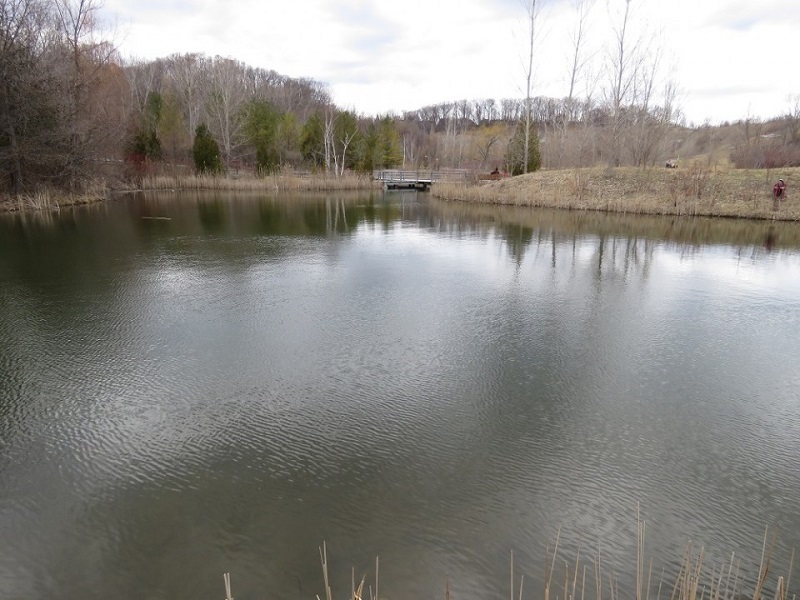
Water in the park. Yellowstone is one of the few national parks where snowmobiles are permitted. In addition, snow coaches - winter buses on skis - provide a unique way to travel. Photo by Elena.