google.com, pub-2829829264763437, DIRECT, f08c47fec0942fa0

Thursday, October 25, 2018

A Champion's Favorite Rivers

A Champion's Favorite Rivers


Where to go for the best whitewater kayaking in the country

Whitewater kayaking is not a sport for the timid. One of the first things any good kayaker learns, in fact, is “the roll”, in which one spins the kayak upside down, placing oneself briefly but enirely under water. As a member of the U.S. Whitewater Team and the 1987 winner of the World Whitewater Championships in France, Bruce Lessels has had plenty of experience rolling his kayak. Here, Lessels, who also is the author of the Whitewater Handbook, and the president of the Zoar Outdoor kayaking School in Charlemont, Massachussets, lists seven of his favorite places to kayak in the United States.

Tuolumne River: Stanislaus National Forest, California: Located near Yosemite National Park in a pristine land reserve, the Tuolumne has 6 miles of expert-only class IV and class V rapids at top. Below are 18 miles of slightly less demanding class IV rapids.

Permits: Granted to only 80 people per day to prevent overcrowding. For permit and river condition information, call the Goveland Ranger District in Stanislaus National Forest.

Rogue River, Southwestern Oregon: Expert kayakers love this river for its class IV and class V rapids. But warm water and a 40-mile run of class II to class V rapids also make it fun for novices.

Schools: Sundance Expeditions Kayak School and Rafting Company, based in Merlin, Ore., offers a nine-day introductory course.

Permits: A limited number are given out through a lottery system with a January 31 deadline for the Memorial Day through Labor Day season.

Loonies. Photo by Elena.

Middle Fork of the Salmon River, Central Idaho: A paddler's favorite, the Middle Fork is 98 miles of remote, wild river appropriate for beginning, intermediate, and advanced kayakers. The water is warm, many of the beaches are sandy, and along the way are excellent hiking, great trout fishing, and beautiful hot springs.

Permits: For private permit information or a list or area outfitters, call the U.S. Forest service, Middle Fork Ranger District.

The Clark's Fork of the Yellowstone River, Southwestern Montana: The whitewater and scenery are awesome, but non-expert paddlers should steer clear; the river's 37 miles of class IV and V rapids have proven deadly for even the most advanced kayakers. Wildlife is plentiful.

Permits: Because there is not a problem of overuse, no permits are required. For more information, call the Jackson Hole Kayak School.

Rio Grande, Big Bend National Park, Texas: Unlike most other American rivers, the Rio Grande is runnable all year. Hot springs warm the water to a perennially comfortable 70 degrees, making the river inviting to even the wimpiest of beginners. Rapids range from class II to class III, but the temperature and scenery make the river popular even with advanced kayakers.

Permits: Required for all paddlers and can be obtained on-site at Big Bend National Park. For more information, call the Park Service at Big Bend.

Chattooga River, South Carolina and Georgia: Deliverance was filmed here. The Chattooga's rapids are some of the most challenging on the East Coast, and the scenery some of the most beautiful. Few have successfully navigated the reacherous class IV section, and many have sustaned critical injuries in the attempt.

Schools: Beginners come here for the Nantahala Outdoor School in Bryson City, N.C. 

Permit: Kayakers running the river on their own can obtain the required permits at the put-in at the U.S. Route 76 Bridge near Clayton, Ga.

Sheenjek River, Arctic National Wildlife Refuge, Alaska: Although the rapids on this river usually do not exceed class II, the temperature and volume of the water combined with the remoteness of the site make this almost a class III challenge. The area is accessible only by seaplane.

Permits: For information, call the Arctic National Wildlife Refuge.

Battery and Hudson Parks

Battery and Hudson Parks in New York City

New York City Parks

Welcome to your park. This is a shared public space provided for your enjoyment and recreation. Dogs must be properly licensed and vaccinated. Be courteous and respectful to others, and please keep the park clean.

The Hudson River Estuary Program


New York State established the Hudson River Estuary Program in 1987 to conserve the estuary’s natural resources and sustain the benefits they provide. Based in the Department of Environmental Conservation, the program partners with state agencies, local governments, and private groups in carrying out projects to protect the ecosystem, promote access to an enjoyment of the estuary, and clean up pollution. The interpretive station, part of a network from Troy to New York City, furthers these aims by increasing public understanding of the estuary.

Park rules prohibit:

  •     Loitering and dumping of debris
  •     Smoking within the park
  •     Barbecuing, except in designated areas
  •     Unleashed dogs, except in designated areas between the hours of 9pm to 9am when the park is open
  •     Using illegal drugs and alcohol
  •     Feeding birds and squirrels
  •     Entering the park after it is closed
  •     Solicitation and obstructing entrances
  •     Amplifying sound, performing and rallying, engaging in commercial activity, and vehicles, except by permit.


A fort or something... This mysterious structure is very big (look at the people walking around). Photo by Elena.
Robert F. Wagner Junior Park. Photp by Elena.


Stephan Weiss 1938-2001. Apple 2000/01. Dedicated by the artist to the city of New York and to the neighbors and neighborhood of the Far West Village that filled his heart. Stephan Weiss Studio. Photo by Elena.
Korean War Memorial. New York Korean War Veterans Memorial. Mac Adams, Artists, dedicated June 25, 1991. Photo by Elena.
The Immigrants. Dedicated to the people of all nations who entered America through Castle Garden. In memory of Samuel Rudin (1896-1975) whose parents arrived in America in 1881. Photo by Elena.
A Middle Ages wall. Photo by Elena.
New residential buildings in the Green village. Photo by Elena.
The path is going through half of New York. Photo by Elena.
The Hudson River park is a perfect place to admire the Hudson. Photo by Elena.
Another portion of this long park. Photo by Elena.
View on New York downtown and the Memorial center. Photo by Elena.

Hudson River trail. Photo by Elena.
American Merchant Mariners' Memorial. To all merchant mariners who have served America from the Revultionary War through the present day in the prosecution of war and in pursuit of peaceful commercie, unrecognized thousands have lost their lives at sea. Their sacrifices have helped secure America's liberty and prosperity. The sculpture was inspired by a photograph of the victims of a submarine attack during World War II. Left to the perils of the sea, the survivors later perished. This memorial serves as a marker for America's merchant mariners resting in the unmarked ocean depths. In recongnition and appreciations. Sculptor Marisol.
1941 - 1945 Erected by the United States of America in proud and grateful remembrance of her sons who gave their lives in her service and who sleep in the American Coastal Waters of the Atlantic Ocean, Into Thy Hands, O Lord
For three decades, this sculpture stood in the plaza of the World Trade Center. Entitled The Sphere, it was conceived by artist Fritz Koenig as a symbol of world peace. It was damaged during the tragic events of September 11, 2001, but endures as an icon of hope and the indestructible spirit of this country. The Sphere was placed here on March 11, 2002 as a temporary memorial to all who lost their lives in the terrorist attacks at the World Trade Center. This eternal flame was ignited on September 11, 2002 in honor of all those who were lost. Their spirit and sacrifice will never be forgotten.
History of New Pier 1: New Pier 1 was designed by General George B. McClellan (of Civil War fame), first Engineer-in-Chief of the Department of Docks. It was constructed between 1872 and 1877 as part of a larger maritime complex that included a wharf and boat landing. The pier was later leased to the Iron Steam-Boat Company, which ran ferries to Coney Island beginning in 1881. The Steam-Boat Company erected a two-story pier building to house a restaurant, a saloon, and a dance hall.
By 1897, New Pier 1 was turned over to freight use, and in 1972, it was demolished to make way for Battery Park City. The white granite inlay in the pavement of this plaza indicates the aproximate location of New Pier 1 and the shorelines circa 1877 and 1886. The water around these piers was infilled in the early 1970s to creat Battery Park City, so the former site of New Pier 1 is now largely within the footprint of Robert F. Wagner Park. Photo by Elena.
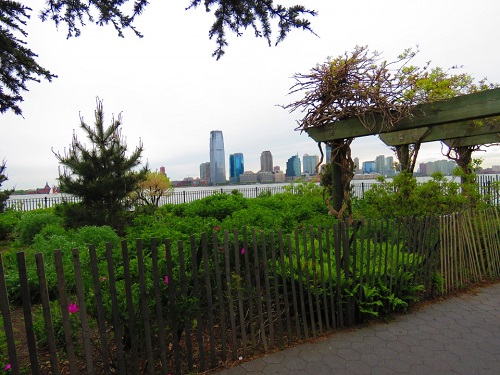
View on New Jersey from the Hudson Park. Photo by Elena.
A structure looking like the head of the statue of Liberty. Photo by Elena.

Wednesday, October 24, 2018

Guide to Whitewater Rapids

A Quick Guide to Whitewater Rapids


River conditions can vary widely and unpredictably. The following ratings were developed to give those unfamiliar with a river a feel for what they are getting into – before the get into it.

  • Class I: Flat water, some current.
  • Class II: Small waves.
  • Class III: Big waves, requires maneuvering through hydraulic holes, in which the water breaks back on itself over a rock.
  • Class IV: Big waves, many rocks, and very fast, powerful water. Requires precise maneuverability. Not fun to swim in if you make a mistake.
  • Class V: Pushing the limits of navigability, should be done only experts. Extremely steep gradient of river: 30- to 40-foot drops. Mistakes of capsizing will result in injury or possibly death.
  • Class VI: Pushing the absurd. Paddlers on the West Coast define it as not runnable. Those on the East recommend it only for experts, lunatics, or both. Injury or death is a distinct possibility.


Learning to paddle. Photo by Elena.

Learning how to paddle


Where to find out more about canoeing or kayaking before getting on the water.

Paddling Clubs: Paddling clubs are a good way to get your feet wet. Those looking for a club close to home should call the American Canoe Association – The largest paddling association in the country, it sets instructor certification tests and general water safety standards. Or North American Paddle Sports Association – also covers kayaking. Can put you in touch with a club near you.

Outfitters: Be sure the outfitter has a trained staff, a clean safety record, and is affiliated with a national paddling organization such as those above. To locate one near you, contact America Outdoors, which lists recreational opportunities with premier backcountry outfitters on public lands and waterways. National Association of Canoe and Livery Outfitters – A professional organization that will put you in contact with members.

Paddling schools: For those who prefer to have some easy experience on the water before embarking on a more challenging trip with an outfitter. Canoe and kayak retailers sometimes offer classes and can also be good sources of other information, including local water conditions. For schools near you refer to: Canoe & kayak magazine, all the news you need, and useful listings and ads from a variety of outfitters and schools.

Trails of Native Americans

Trails of Native Americans

Where the traffic is low on America's original superhighways


The weekend traffic is approaching bumper to bumper. And no wonder. Canoe Magazine estimated in 1992 that some 14 million Americans participate in some form of paddling sport every year, be it canoeing, whitewater kayaking, sea kayaking, or rafting. To make matters worse, more and more rivers are polluted or unsuited for paddling. For every mile of American river that's preserved, say experts, 85 miles are plugged with concrete.

Traffic jams in America's waterways are nothing new, however. America's history is full of the canoe exploits of adventurers such as René-Robert La Salle, who discovered and named Louisiana, and Jacques Marquette, the French explorer and Jesuit priest who first reported accurate data on the course of the Mississippi. And the Europeans, of course, were only taking their cue from nearly Native Americans, who perfected canoe travel and used rivers much more than overland routes.

The good news: Many of the routes originally mapped by Native Americans remain in, or have been restored to pristine condition. Native Trails works to preserve pre-mechanized travel routes. Below are its top eight picks for canoe routes you can still travel today that look much as they did centuries ago.

Boundary Waters: Grand Portage, Minn., to international Falls, Minn. Length: 160 miles. 10 days. The key highway for Native Americans and Canadian Voyageurs in the rich fur trade west of the Great Lakes. The route is still a wild chain of granite-reefed lakes and backwater rivers, little changed from the days of the bitter rivalry between the Northwest and Hudson Bay companies. Though little whitewater skill is needed, good judgment on wind-whipped lakes and stamina for portages are necessities.

Landscape. Photo by Elena.

Coosa Trail, Carters, Ga, to Coosa, Ga. Length: 150 miles. Seven to 10 days. Next to Carters, Ga., is the archeological site of Liitle Egypt, where 16th-century Spanish explorer Hernando de Soto raided the temples that crowned the city of Coosa's earthen pyramids. The raid yielded no gold, so de Soto marched on, leaving behind only the plague of smallpox, inadvertently destroying the Coosa people. The pristine route allows for keen appreciation of this former center of the Native American kingdom..

Eastern Ohio Trail: Cleveland, Ohio, to Marietta, Ohio, Length: 270 miles. 15 days. The Cuyahoga River was so polluted in 1967 that is caught fire. Today, it is a model of recovery. Its valley leads south to waterfalls and on old portage route to the Tuscarawas and Muskingum River system. French explorers, settlers, and the Ohio Canal all followed the water trail to the Ohio River. Though no longer wild, the scenery is still beautiful as the rivers wind through the western edge of the Appalachians.

Missouri Breaks: Fort Benton, Mont,, to James Kipp recreation Area, Mont. Length: 160 miles. Seven days – Much of the upper Missouri has become a series of shallow, windswept lakes, hostile to canoes. This federally protected section escaped that fate. The painted cliffs of the Badlands hem the river from Virgelle to the end. Good current and few rapids make this an easy, scenic trip.

Northern Forest Canoe Trail. Old Forge, N.Y., to Ft.Kent, Maine. Length: 680 miles. 1 t0 2 months: Like the Appalachian Trail, it traverses the wildest regions remaining in the Northeast. Some sections are not marked, but the trail is usable throughout – beginning where the St. John and Fish rivers meet at Fort Kent and following more than 15 rivers across the Adirondacks, Vermont, New Hampshire, and ending in Maine. Some sections are easy, others are broken by difficult rapids. Intermediate (class III) whitewater skills are needed to do the entire route. There are at least 30 mandatory portages on the trail.

Potomac Heritage Trail. Old Town, Md.. to Piscataway National Park, Md. Length: 200 miles. - Eight to 10 days – The Potomac was the Native American's major highway through the Appalachians. Most miles are easy, but rapids and falls break the river at Harpers Ferry and between Seneca and Georgetown. Many of the falls require portages for other than expert canoers. The last portion of the trip, just before Georgetown, is in tidewater, so paddlers need to plan their trip according to tidal charts.

Rogers Retreat: Newport, Vt., to Williams River Landing near Bellows Falls, Vt. Length: 260 miles. Ten days. Charts one of the boldest initiatives of the French and Indian War: the attach on St. Francis, Quebec, by Robert Rogers and his rangers. Experience the agony of victory by climing slowly up the Clyde River, racing and portaging down the Nulhegan and Connecticut rivers, then up the Johns River to portage the ammo for a long downriver run to where the Rangers finally reached a safe retreat. The route is difficult but rewarding.

Wisconsin Trail : Menasha, Wis., to Prairie du Chien, Wis. Length : 240 miles.!4 days. Indian guides introduced this route to Europeans in the middle of the 16th century. The route has pretty, in not particularly wild, scenery starting with Lake Winnebago, ascending the slow-moving Fox River, and finally following the Wisconsin River past the Baraboo Range and into the hills of western Wisconsin. Some short portages at a few dams are required along the way.

Monday, October 22, 2018

Best Places on the Planet

The Best Places on the Planet

The United Nations has declared these sites to bi vital to humanity


Without doubt, the most difficult landmark designation to obtain is that of a World Heritage site. Established by the United Nations Education, Scientific, and Cultural Organization's general conference in 1972, the World Heritage Convention chooses sites that members feel have such outstanding value that “safeguarding them concerns humanity as a whole.”

Today there are about 400 designated World Heritage sites in more than 80 countries. Signatories to the convention not only agree to forever preserve sites located within their own territory, but also to respect designated sites in other countries. Following is a list of the 18 sites included on the list in the United State:

Cultural Sites


Cahokia Mounds State Historic Site, Illinois:

The low bluffs and alluvial terraces of this region where inhabited by large numbers of pre-Columbian people. Here they built a major agricultural and trading base that extended 1.2 million square miles, to include Monk's Mound, probably the largest prehistoric earthen site in the New World. The mound is larger at the base than the greatest of the Egyptian pyramids, although, at 108 feet, it is not as tall.

Chaco Culture National Historical Park, New Mexico:

The pinnacle of pre-Columbian civilization in the United States, this site is also the largest, with over 2,800 archeological sites and the ruins of 13 major pueblo villages.

Independence Hall, Pennsylvania:

This two-story, red brick structure was the seat of the U.S. Government through the 1780s until 1790, when Washington, D.C. Was designated the capital.

La Fortaleza and San Juan Historic Sites, Puerto Rico: Both sites are part of the fortifications that surround San Juan and together make up the largest historic fortifications in the Americas. La Fortaleza dates from the mid-16th century, evolved into a 19th-century palace, and today is the residence of Puerto Rico's governor.

Mesa Verde, Colorado: this site has the most complete record of the Anasazi culture in existence, including ceremonial shrines and residences, that range from one-room houses to enormous cave villages.

Green Bridge. Photo by Elena.

Monticello and the University of Virginia, Virginia: Jefferson drew his ideals of universal freedom, self-determination, and self-fulfillment from Greek and Roman precepts. Here he built stunning neoclassical structures that embody those ideals. Monticello, his home, was built between 1784 and 1809, and the university was built between 1805 and 1824.

Statue of Liberty, New York: This symbol of freedom was presented to the United States by the government of France on the occasion of the first centennial in 1876. The 151-foot figure is dressed in a Roman toga with a torch in her right hand. In her left is a tablet marked July 4, 1776. She is stepping forward from shackles of slavery – a broken chain lies below her feet.

Pueblos de Taos, New Mexico: Taos is a prehispanic town that has successfully retained many of its early traditions. It was founded by the Anasazi Indians of the prehistoric period, and remarkably today most of the multitiered adobe buildings have retained their original forms, changed only by the addition of a few new external doors and windows, and modern fireplaces.

Natural Sites


Everglades National Park, Florida: The largest subtropical wilderness in the United States, the Everglades are a heaven for over 800 vertebrates. In addition, the park has one of the greatest natural history, and environmental education centers on earth.

Grand Canyon National Park, Arizona: The Grand Canyon's walls, a mile deep at some points, are a geological record that reaches back some 2 million years. Also in the area are ruins from the ancient people who lived in the rugged environment.

Great Smoky Mountains National Park, North Carolina and Tennessee: In addition to one of the last great virgin forests in North America, this park contains one of the largest collections of fungi, mosses, and lichen in the world.

Hawai'i Volcanoes National Park, Hawaii: Here, active volcanoes rise directly from the Pacific Ocean floor. They have provided the best records and understanding of of volcanic activity on earth. Also throughout the park are numerous archeological sites that indicate that indicate the understandable reverence early Hawai'ian peoples had for the volcanoes.

Mammoth Cave National Park, Kentucky: The largest cave system on earth, with hundreds of miles of charted chambers. In fact, the known chambers are 10 times as extensive as the next-largest cave system.

Olympic National Park, Washington: The park contains one of the largest temperate rain forests remaining on the planet. Its relative isolation on a peninsula accounts for the park's many rare plant and animal species.

Redwood National Park, California: The park contains the three largest trees on earth – the largest is 468 feet. Redwood also has archeological sites stretching back to 300 b.c., including well-preserved semi-subterranean plank houses, sweathouses, and crematoriums.

Wrangell-St.Elias National Park, Alaska: Contains the largest number of glaciers and greatest collection of peaks over 16,000 feet on the continent. One of the most unspoiled national parks in the United States.

Yellowstone National Park, Idaho, Montana and Wyoming: The central third of the oldest national park in the United States is the largest volcanic crater on earth. In addition there are 27 fossilized forests, and over 10,000 geysers.

Yosemite National Park, California: The multitude of glacial features found here is virtually unmatched in the world.

Stunning photographs and essays by world-renowned figures about all World Heritage sites can be found on many websites.